FULL MOUTH REHABILITATION
How to Restore One Arch of the
Mouth When the Other Is All
Implants and a Fixed Bridge
A patient story about saving natural teeth where possible, and
blending them with an implant-supported arch in perfect harmony.
VUE DENTAL KYLE • PATIENT STORY
One arch of implants, one arch of natural teeth
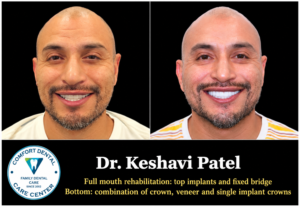
As full-mouth rehabilitation gets more and more common, a pattern has emerged. Typically about 60% of these cases are implants on the top and implants on the bottom — both arches fully implant-supported. But about 40% of these cases include one arch of natural teeth. This case was exactly that second kind. The top teeth were restored with all implants and a fixed bridge — what is known as an all-on-X procedure. The entire upper arch is supported by implants, and the bridge itself is fixed in place. It does not come out.
The patient presented almost after the top procedure was done, just as the final prosthesis was coming — and wanted the bottom to match the top. The bottom teeth were natural teeth, but with a few things to note: significant wear, some decay, and the bottom right side tooth missing, where a single implant had already been placed.
The goal was twofold: match the aesthetics, and make the bite work. That second part is the real challenge here. With titanium on the top and natural teeth on the bottom, the bite has to be restored in a way that protects the bottom teeth long term — so they do not break under the stronger opposing arch.
Designing the smile around what he wanted
Then we sat with the patient and discussed the smile design process, and his goals for his teeth in terms of the look. Our patient was wonderful — and very
exacting. He wanted a certain look and outcome for his teeth, and that guided the design from the start.
Those points were communicated to the lab: the cosmetics, the function, and protecting the bite long term to prevent the bottom teeth from breaking down
further.
Materials chosen for strength and looks
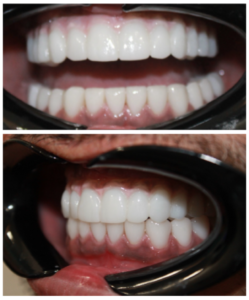
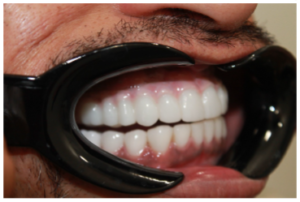
Material selection was really important for that. For the back teeth, the premolars and molars, zirconia crowns were used — strong enough to stand up to the implant bridge above. For the front four, e.max veneers with adequate thickness gave the aesthetics without giving up strength. And the missing bottom right tooth was restored with a single implant crown.
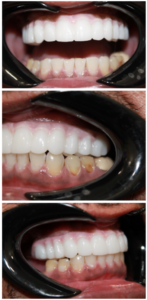
Records at presentation: the restored upper arch against the worn, natural lower teeth.
The smile test drive, then the finals
That is why the process uses a smile test drive. After the first consult and records, the teeth are shaped and temporaries are placed, giving a trial smile that aims for 80 to 90 percent of the final look. Function and appearance are confirmed while there is still room to adjust.
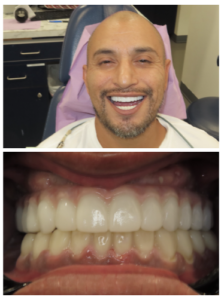
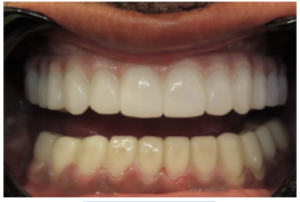
Once the temporary bite was equilibrated, we proceeded to the finals — the permanents were made and placed, followed by post-op bite checks.
From start to finish, the treatment timeline was 4 to 6 weeks.
Once the temporary bite was equilibrated, we proceeded to the finals — the permanents were made and placed, followed by post-op bite checks.
From start to finish, the treatment timeline was 4 to 6 weeks.
Why not all-on-X for both arches?
More and more patients are seeking long-term care for their teeth. The all-on-X procedure is remarkable because it now provides patients a stable replacement for their teeth — it adds form and function, and looks great cosmetically. But as we do more and more of these procedures, it is important for patients to learn about what if only one of the arches needs the all-on-X procedure. It is very predictable to use your natural teeth against implants, with all-on-X on the top or the bottom. The purpose is to try not to jump into all-on-X for both arches when it is not required — save your natural teeth when indicated, get the all-on-X where it is needed, and both can blend in perfect harmony.
READY TO TALK ABOUT YOUR SMILE?
Schedule a consultation with Dr. Patel at Vue Dental Kyle to explore a plan designed around your goals.